Aptly replaces the spreadsheets, PDFs, and email chains that hold your authority matrix today with one live, auditable registry of who can approve, sign, and commit, at what limits, and granted by whom. Connected to your HR, identity, and business systems, so it stays current as your organization changes.
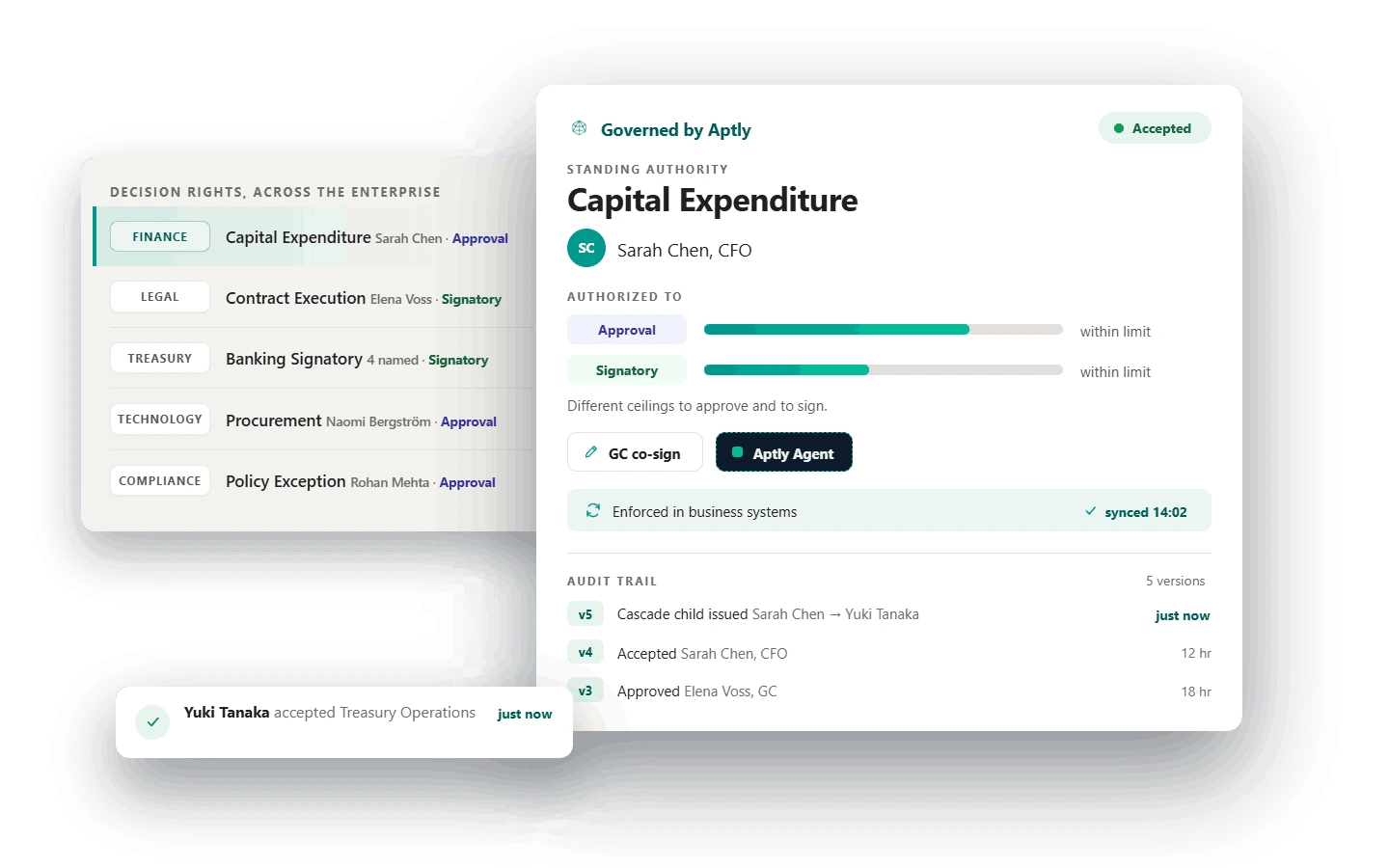



Aptly turns delegation of authority from static documents into a living system. Define it once, keep it current automatically, and prove it on demand.
Set who can approve what, up to what amount, under what conditions, across every entity. Build authority matrices and signatory lists in a structure your teams can actually navigate, with limits, conditions, and roles attached to each decision type.
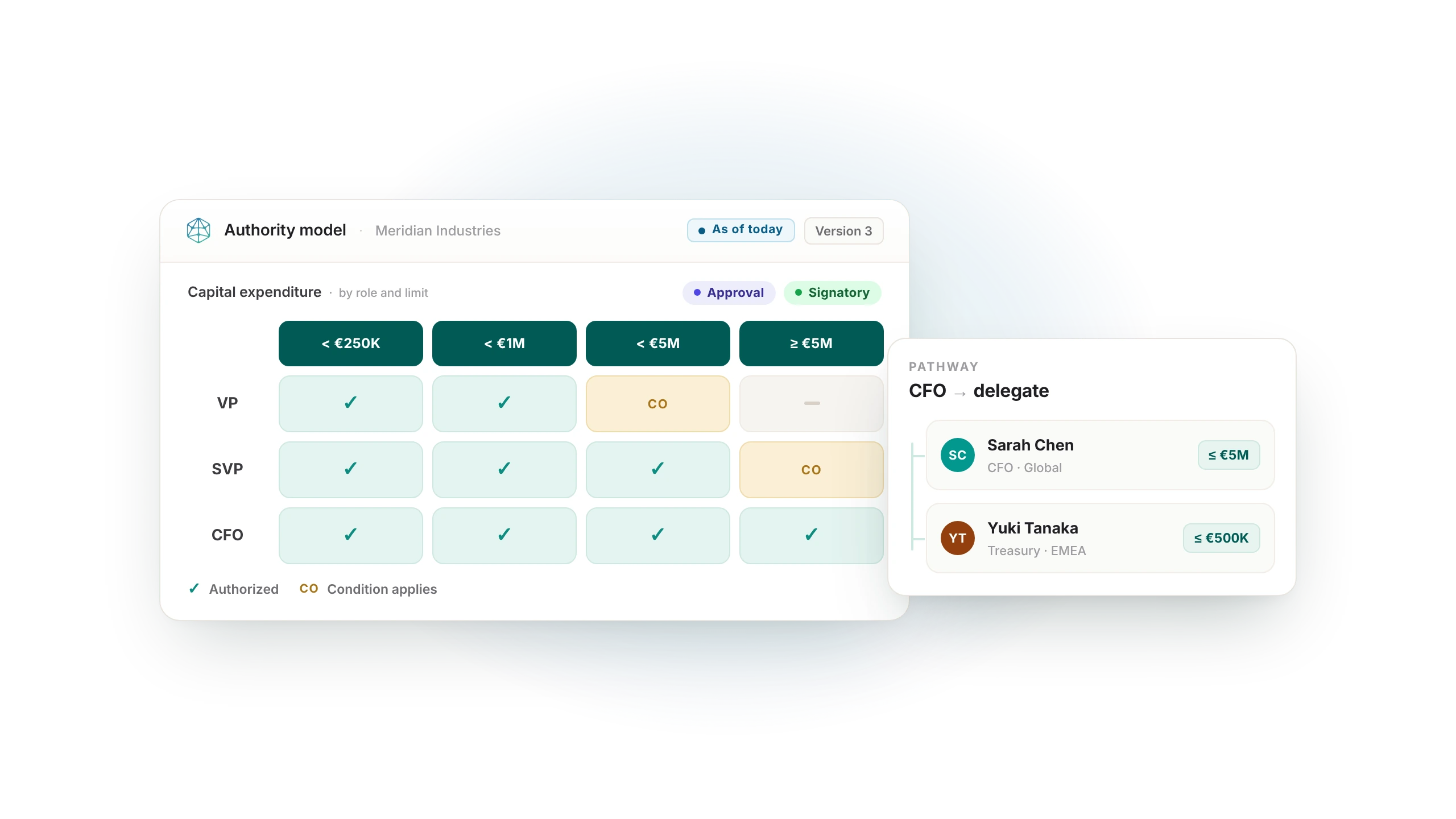
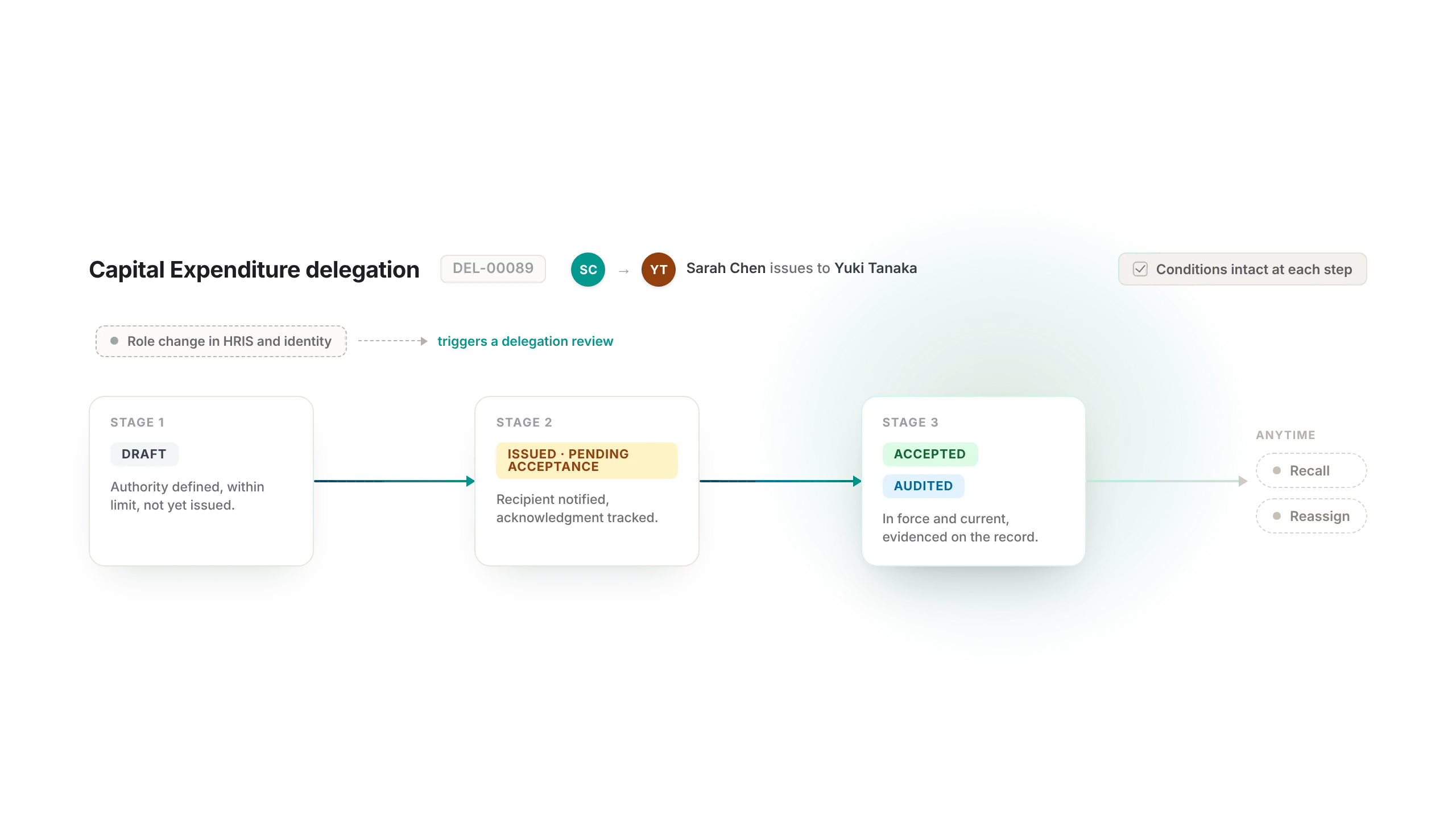
Issue, acknowledge, recall, and reassign delegations in real time. Cascade authority from the board to the front line, with redelegation that never exceeds its source. When someone changes roles, connected HR and identity data trigger a delegation review instead of a missed update. Anyone can find out who can approve a given decision in seconds.
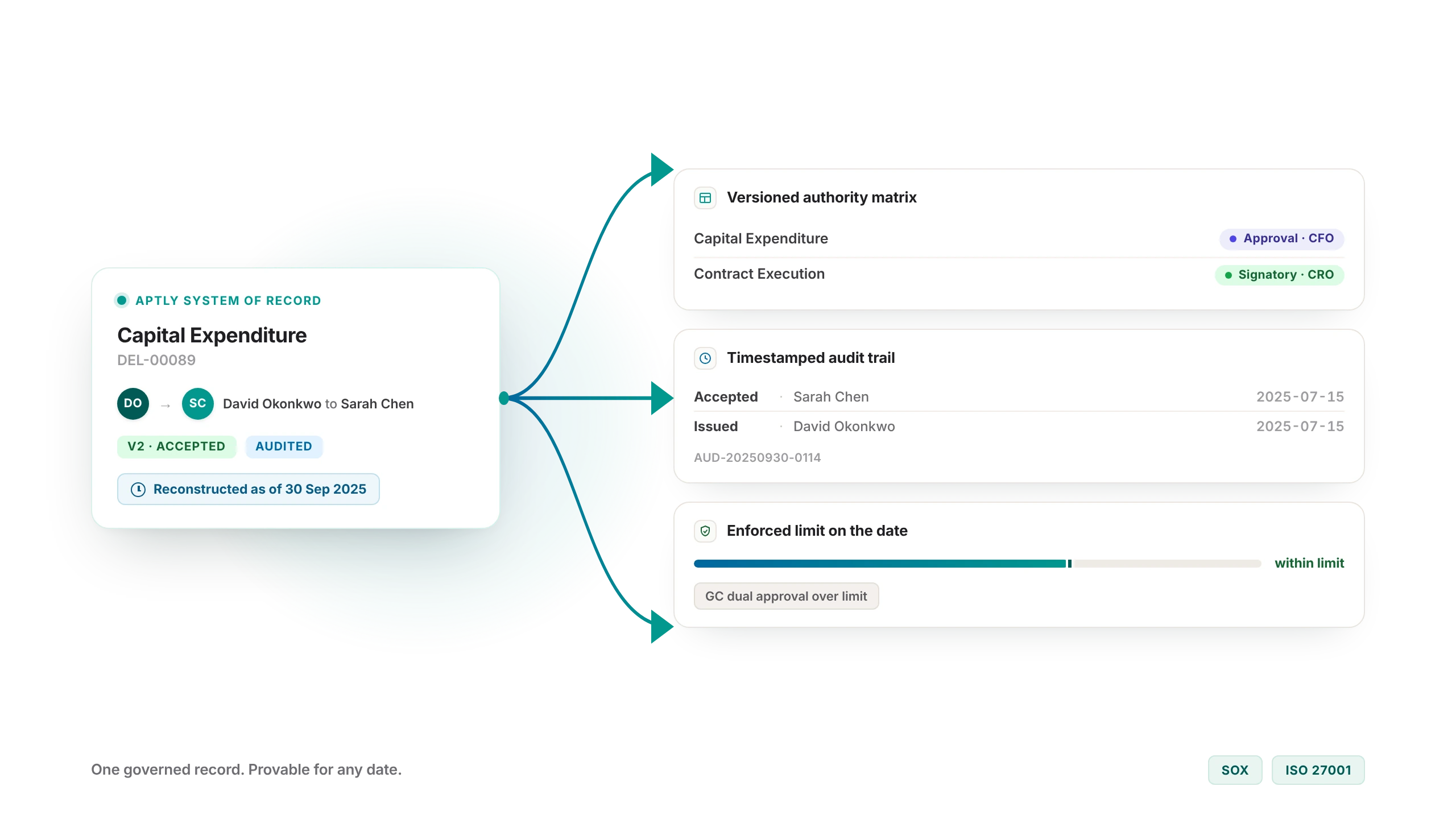
Point-in-time recall reconstructs the full authority state for any past moment, including dates years ago during an audit or litigation hold. Every issuance, acknowledgment, and change is tracked and attributed. Audit-ready by default, not by reconstruction.
Most organizations govern authority with tools that were never built for it.
No major GRC, ERP, workflow, or identity platform provides purpose-built delegation of authority management. Aptly does.
Identity platforms answer one question: can you access this system? Aptly answers a different one: are you authorized to make this decision, up to what limit, and who is accountable? That is the difference between access and authority, and no identity, GRC, or ERP platform is built to answer it across your whole organization.
The authority layer for the enterprise. Aptly sits between identity management and business systems, providing the missing governance layer that defines who can approve, sign, and commit on behalf of the organization.
Aptly provides teams the visibility needed to navigate financial and non-financial decision authorities and take action while ensuring alignment with accepted governance, risk management, and compliance standards.
Complete authority governance — Delegation of authority, signatory list management, and RACI frameworks in one platform
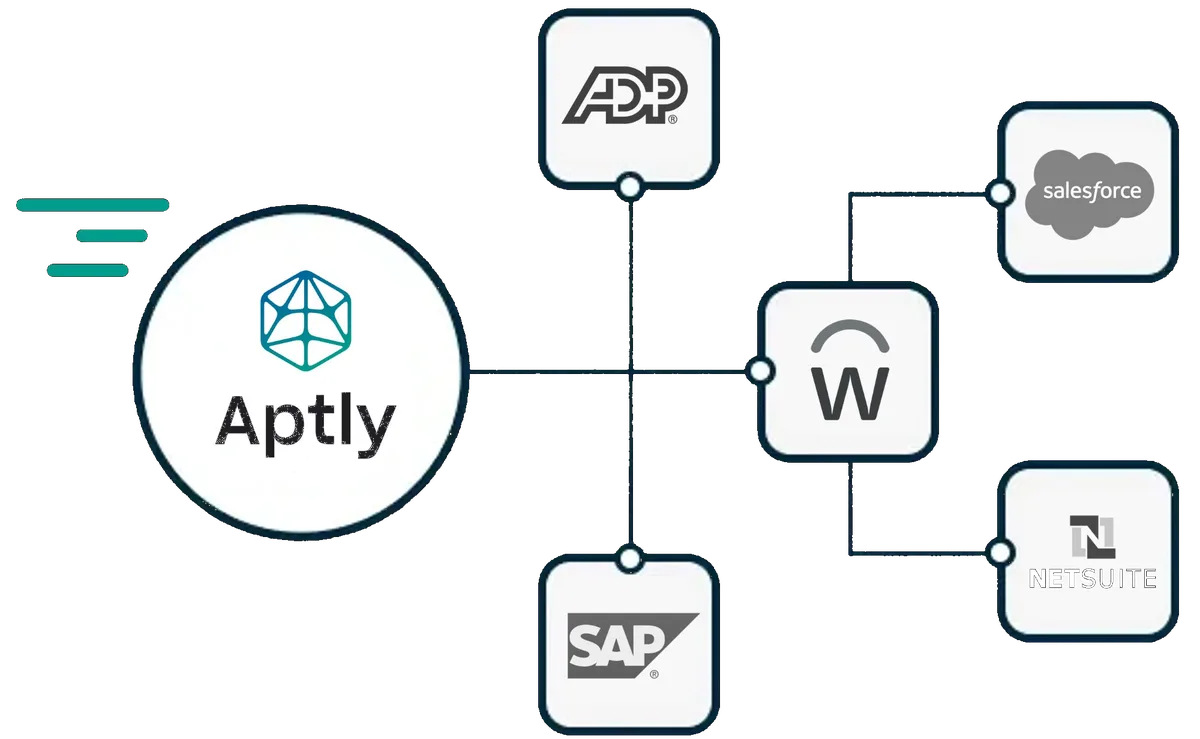
30+ enterprise integrations — Sync authority data to Workday, SAP, NetSuite, Oracle, Microsoft systems and dozens of other platforms via Aptly connectors
Audit-ready from day one — SOC 2 Type II certified and GDPR compliant with full version history and action logs
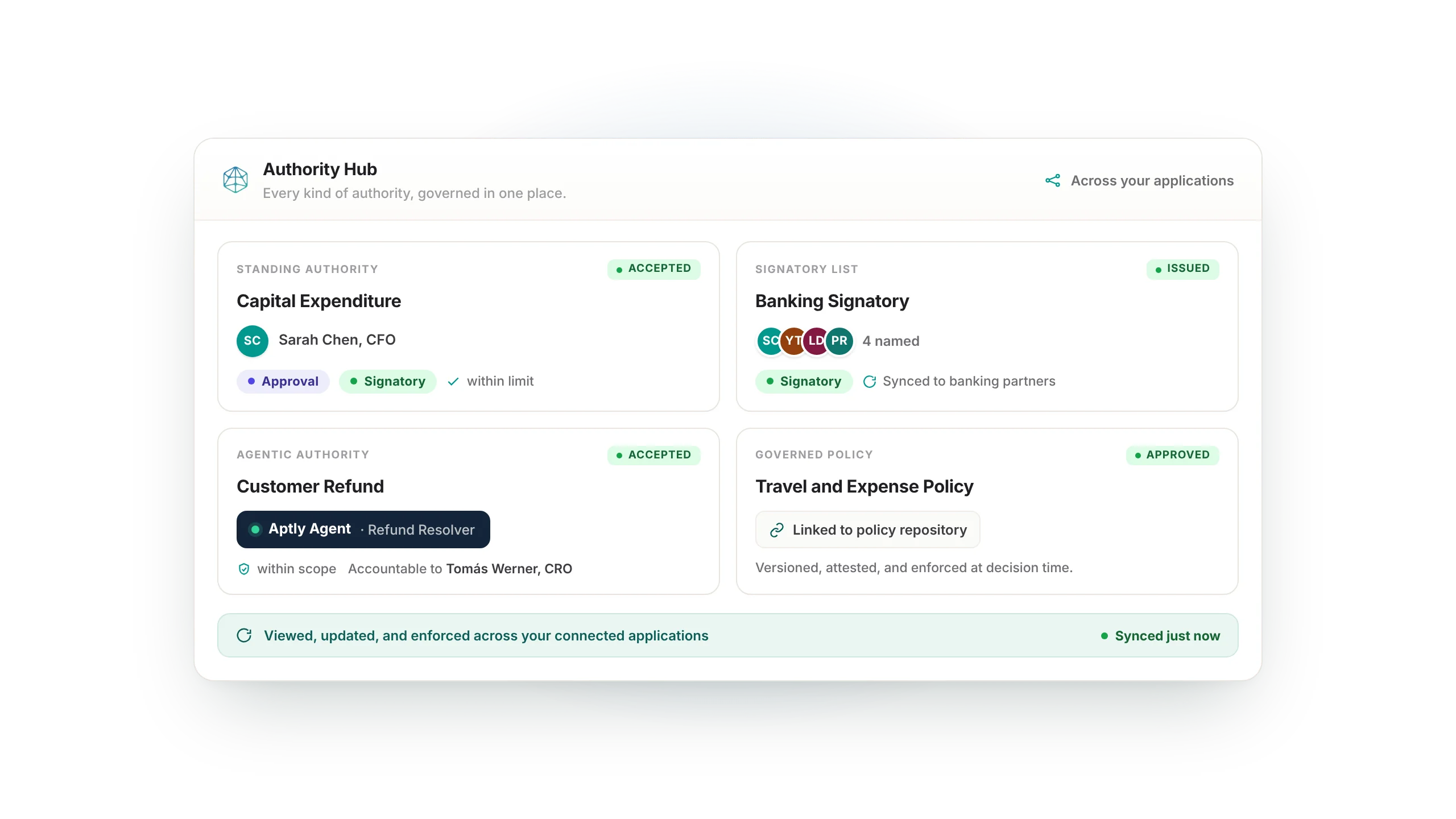
Create, structure, and distribute delegated authority throughout your business. Aptly digitizes the traditional, static authority matrix, making it easier for teams to understand and navigate decision rights, streamlining approvals to work faster and remain compliant.


Improve delegate accountability with tracked acknowledgements staff have read and understood their delegations at all levels of the organization.
Learn more ➝
Digitize authorized signatory lists to reduce the risk of contract disputes and signatory fraud while improving business processes and corporate governance.
Learn more ➝
Grant time-based or expiring delegations. As staff and positions change, users receive notifications to review and accept current delegations for their role.
Learn more ➝
Leverage industry proven RACI-based delegations to assign individuals as Responsible, Accountable, Consulted or Informed. Configure and assign additional role types to support unique business requirements.
Learn more ➝
Configure role-based visibility up and down the authority matrix and across business units. Publish delegations directly to a company website to ensure public delegations are always current.
Learn more ➝
Verify actions and change history for all delegations and authorizations. Leverage pre-built integrations to view and track authorities across your existing applications.
Learn more ➝Solutions
One authority layer, applied to the decisions your teams make every day.
Approval rights synced to every ERP and app.
View use case →
Clarity on who decides, approves, and signs.
View use case →
Audit-ready control evidence across every framework.
View use case →
Governance for what AI agents do on your behalf.
View use case →
One authority layer across every entity and jurisdiction.
View use case →
Daily authority proof, not quarterly reconstruction.
View use case →
Agentic governance
Identity systems govern what an AI agent is and what it can access. Aptly governs what it is authorized to decide, approve, sign, and commit, on the same matrix as your people, with named accountable owners, enforced escalation above its limits, and every action logged.
82% of organizations already use AI agents. Only 44% have policies in place to secure them.
Survey of 353 enterprise security professionals, conducted by Dimensional Research.
Bring your own authority structure to a working session and see how Aptly digitizes it.
Getting decision rights right
SAP's CEO says enterprise AI runs on execution, not prompts. The execution layer most teams are missing is provable authority.
Why public companies can no longer rely on spreadsheets to manage delegation of authority, and what the shift to purpose-built platforms looks like in practice.
Most enterprises still manage delegation of authority in spreadsheets. Download our white paper on the costs, compliance risks, and emerging technologies reshaping how organizations govern decision rights.
FAQ
What is delegation of authority software?
Delegation of authority software replaces static DOA matrices and spreadsheets with a live system of record. It defines who can approve, sign, and decide, with limits and conditions, tracks issuance and acceptance, and maintains a complete audit history of every change.
How is signatory management different from e-signature tools?
E-signature tools facilitate the act of signing. Signatory management governs who is authorized to sign on behalf of the organization. Aptly maintains validated, current authorized signatory lists with limits and effective dates, shared with banks, counterparties, and internal teams in real time.
How does Aptly keep authority current as people change roles?
Aptly connects to your HRIS and identity systems, so role changes trigger reviews of the authority attached to a position. Delegations can expire, transfer, or require re-acceptance, and the authorized signatory list updates with them, keeping records aligned with organizational reality.
Can Aptly govern AI agents as well as people?
Yes. Aptly governs human and AI-agent authority on the same matrix. An agent holds scoped authority with limits and conditions, a named accountable owner, and enforced escalation above its scope. Every agent action is logged alongside human approvals.
What systems does Aptly integrate with?
Aptly syncs authority data with identity and execution systems, including Workday, SAP, Oracle, NetSuite, Microsoft systems, and ServiceNow, through Aptly connectors. Authority defined in Aptly can be viewed, updated, and enforced across connected applications.